
A first-time assault arrest in Georgia usually means a misdemeanor charge with a realistic path to diversion, but release still depends on posting bond at the Cherokee County Adult Detention Center. In Washington domestic-violence data, 88% of charges against first-time offenders were misdemeanors, although assault also appeared in felony cases and conviction outcomes varied by charge severity (Washington domestic-violence case analysis).
If you're reading this from a patrol car, a jail lobby, or a bedroom where your family is trying to locate someone who hasn't called, focus on the next decision, not the worst possible sentence. First-time offender assault charges can lead to diversion, a negotiated resolution, probation, or custody, but first-offender status doesn't automatically produce a low bond or make the case disappear.
The immediate job is practical: confirm where the defendant is, learn the charge and bond amount, contact a criminal defense attorney, and decide whether to use cash, property, or a licensed bondsman. This guide covers both sides of the problem, the courtroom outcome and the Cherokee County release process.
What Happens in the First Hours After a First Time Assault Arrest
The first call often comes from the back seat of a patrol car. The defendant may sound frightened, angry, or confused, while the family member listening tries to understand whether the person is being taken to the Cherokee County Adult Detention Center or another facility. At that point, arguing about the facts over the phone won't help. The priority is locating the defendant and confirming the booking destination.
After transport, deputies move the defendant through intake. That normally involves identity questions, medical screening, fingerprinting, a photograph, property inventory, and a change into jail clothing. Personal items are recorded and stored according to facility procedure. The defendant may then wait in a holding area while staff complete checks and determine the next step.
Why booking time matters
Booking isn't a single instant. It can involve several stages, and the wait may feel longer when the jail is processing multiple arrests or handling a busy shift. The defendant may not know the bond amount until booking information and the initial judicial review are complete.
The first phone call matters because it creates the family's first reliable information point. Write down the defendant's full name, date of birth, booking charge, case number if available, and any stated bond amount. Don't rely on a rushed memory or a social media post.
Practical rule: The bond amount is the number that turns panic into a decision. Get it directly from the jail or Bond Administration before paying anyone.
Families can review the steps after an arrest in Cherokee County while they confirm the defendant's location. Once the amount is known, ask whether the bond has special conditions, whether a bondsman can post it, and what identification or paperwork the jail requires.
The defendant should avoid discussing the facts with other inmates, friends, or anyone besides a lawyer. The family should avoid contacting the alleged victim about changing statements or dropping the case. That contact can create a new problem even when everyone believes the original incident was a misunderstanding.
How Georgia Classifies First Time Assault Charges
Georgia assault terminology confuses people because everyday language and statutory labels don't always match. A prosecutor may evaluate whether the allegation describes simple assault, simple battery, family violence, or a more serious form of assault. The charge level depends on the alleged conduct, injuries, victim, weapon, and surrounding facts.
Under O.C.G.A. 16-5-20, simple assault generally concerns an alleged attempt to commit a violent injury or an act that places another person in reasonable fear of immediately receiving a violent injury. O.C.G.A. 16-5-23 addresses simple battery, which generally involves alleged intentional physical contact of an insulting or provoking nature, or intentional physical harm. The exact accusation and charging language matter more than the label used during the arrest.
The misdemeanor and felony line
Simple assault and simple battery are commonly treated as misdemeanor-level offenses, but that doesn't mean every first arrest stays there. Aggravated assault, weapon allegations, serious injuries, or certain protected victims can move the case into felony territory. Family violence can also affect bond conditions, charging decisions, and negotiations even when the underlying conduct resembles a misdemeanor.
A first offender usually means the person has no prior felony conviction and hasn't previously received first-offender sentencing. That status can help during negotiations, but misdemeanor history, prior arrests, the facts of the current allegation, and compliance after release can still influence the State's position. An arrest that was dismissed isn't a conviction, yet it may still arise in discussions and should be disclosed to counsel.
| Charge | Classification | Max Penalty | First Offender Eligible |
|---|---|---|---|
| Simple assault | Commonly misdemeanor-level | Depends on the charged offense and sentencing order | Potentially, subject to eligibility and case facts |
| Simple battery | Commonly misdemeanor-level | Depends on the charged offense and sentencing order | Potentially, subject to eligibility and case facts |
| Family violence assault or battery | Often misdemeanor-level, with fact-specific enhancements | Depends on the charge, victim relationship, and enhancements | Potentially, but release and plea terms may be stricter |
| Aggravated assault or weapon-based assault | Felony-level | Depends on the statute and alleged conduct | Possible in limited circumstances, but first-offender status doesn't erase felony exposure |
Injuries, weapons, vulnerable victims, prior convictions, and alleged violations while on release can all change the practical posture of a case. Don't decide what will happen from the word “first” alone. Have a lawyer compare the accusation, arrest paperwork, witness accounts, photographs, and medical information.
Real Penalties and Outcomes for a First Assault Offense
A first simple assault case can end very differently from another case carrying the same basic label. One defendant may qualify for a diversion program and work toward dismissal. Another may receive a conviction with probation, fines, restitution, or a short jail term because the facts, victim relationship, injury, or release conduct are more serious.
For a Georgia misdemeanor, the statutory ceiling can include up to 12 months in custody and a $5,000 fine, along with applicable surcharges and restitution where injury caused a financial loss. Those figures describe maximum exposure, not a prediction. A clean record may improve the starting position, but it doesn't guarantee that the court or prosecutor will treat the case as minor.
What usually moves the outcome
The most important practical factors are the evidence and the defendant's conduct after arrest. Prosecutors examine whether the victim will cooperate, whether independent witnesses or recordings exist, whether an injury is documented, and whether the defendant follows every release condition.
A diversion or pretrial intervention offer may require an admission of facts, counseling, community service, restitution, or other terms. Successful completion can support dismissal, while failure to comply can return the case to active prosecution. Conditional discharge, accountability courts, probation, and negotiated pleas may also be considered depending on the jurisdiction and the defendant's circumstances.

The best early objective is not to promise dismissal. It's to preserve every available outcome while preventing a new violation from narrowing the choices.
A conviction can affect employment screening, professional licensing, housing, and future negotiations. Record restriction or expungement questions must be handled under the applicable Georgia rules and the specific disposition. Don't assume that completing probation automatically produces the same record result as a dismissal or first-offender disposition.
For a plain-language overview of the charge itself, review what a simple assault charge means in Georgia. Then take the arrest paperwork to defense counsel. A bondsman can help with release, but only an attorney can advise on pleas, evidence, diversion eligibility, and record consequences.
Plea Options Every First Time Defendant Should Understand
A first-time defendant generally faces three strategic paths, although the available resolution depends on the facts and the prosecutor's position.
Diversion is designed for eligible defendants who can complete conditions without receiving an ordinary conviction. The prosecutor may look for a clean record, willingness to accept responsibility for qualifying conduct, victim cooperation, and the absence of aggravating features such as a weapon or significant injury. Completion can lead to dismissal, but the defendant must understand every condition before agreeing.
A negotiated plea may involve a reduced charge, such as simple assault or disorderly conduct, probation, classes, restitution, or first-offender treatment. A plea resolves uncertainty faster, but a straight guilty plea creates a conviction unless the negotiated disposition provides a different legal result. Speed is useful only if the record consequence is acceptable.
A bench or jury trial preserves the State's burden of proof and may lead to an acquittal, but it also carries the greatest exposure if the fact finder returns a guilty verdict. Trial decisions require a careful review of statements, recordings, photographs, witnesses, defenses, and weaknesses in the State's evidence.
| Path | Typical Eligibility | Record Outcome | Typical Duration | Best Fit When |
|---|---|---|---|---|
| Diversion | Eligible first offender with manageable facts and willingness to complete conditions | May result in dismissal after successful completion | Depends on the program terms | Avoiding a conviction is the central goal |
| Negotiated plea | Defendant and prosecutor can agree on charge and sentence | Usually creates the record result stated in the agreement | Often more predictable than trial | Evidence supports resolution and terms protect the defendant's future |
| Trial | Defendant contests the charge or rejects the proposed resolution | Acquittal avoids conviction, guilty verdict creates exposure | Depends on preparation and court scheduling | The evidence has meaningful weaknesses or a viable defense |
Conduct on release can determine which door remains open. Follow no-contact orders, don't discuss the case online, don't threaten or pressure witnesses, and appear for every court date. An experienced Cherokee County defense attorney can assess whether diversion, negotiation, or trial fits the evidence instead of selling a guaranteed result.
Bail, Bond, and Release in Cherokee County
Cherokee County's Adult Detention Center is at 498 Chattin Drive, Canton, GA 30115. The Sheriff's Office lists the main jail line as 678-493-4200 and Bond Administration as 678-493-4164 (Cherokee County Sheriff's bond information). Use those official contacts to confirm booking status, bond information, and accepted payment procedures.
The sequence is straightforward, even though the wait can be stressful:
- Arrest and transport: Officers take the defendant to the detention center for processing.
- Booking: Staff confirm identity, complete intake procedures, and record the charge.
- Initial judicial review: The magistrate process determines whether bond is available and what conditions apply.
- Bond selection: The family chooses cash, property, or a surety bond through a licensed bondsman.
- Jail processing: Staff review the paperwork and release conditions.
- Release: The defendant leaves with court obligations and any restrictions attached to the bond.
What the money means
Georgia law caps a surety's compensation at 15% of the face amount of the criminal bond, with a minimum charge of $50 per bonded charge or offense (Georgia surety compensation statute). For example, on a $5,000 bond, the 15% premium is $750, before any separately required amount, collateral, or agreed administrative costs.
Georgia also imposes an additional 10% sum when posting bail or bond in a criminal or traffic case, a separate rule from the surety premium cap (Georgia additional bond penalty provision). Ask the bondsman to identify each amount before signing. Don't confuse the premium with the full face value of the bond. A cash bond requires the family to provide the required cash directly, while a property bond uses qualifying property subject to approval and paperwork.

Cherokee County guidance says cash bonds are handled through the County Court Clerk's Office, and debit or credit card payments may be available through the county's designated system. County jail resources also identify the detention center as the central booking location and recommend confirming the exact bond, booking status, and release requirements directly with officials before payment (Cherokee County detention and bond information).
Assault-related releases may include no-contact, travel, curfew, or monitoring conditions. Read every condition before leaving. A fast release is useful only if the defendant understands what conduct could send them back to jail.
For a plain-language explanation of the local process, use this guide to how bail bonds work in Cherokee County after an arrest.
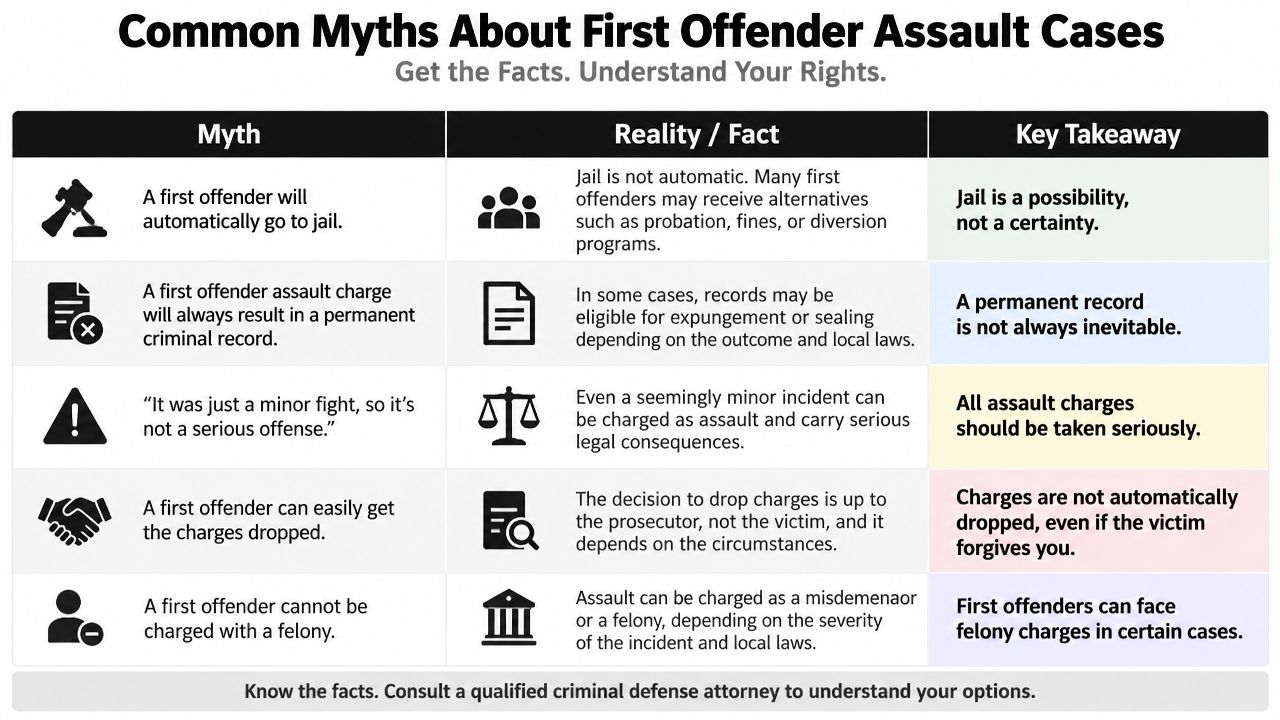
Common Myths About First Offender Assault Cases
Myth one: A first arrest guarantees a light charge. Simple assault is commonly misdemeanor-level, but family violence allegations, battery, injury, weapons, protected victims, and aggravated assault can change the case. First-offender status helps, but it doesn't override the alleged conduct.
Action: Have a criminal defense attorney review the exact accusation before arraignment. Don't build a strategy around what someone called the charge in a phone conversation.
Myth two: Bond will be low and easy to post. The bond amount depends on the charge, safety concerns, criminal history, court assessment, and release conditions. Even after payment, jail staff may need to verify paperwork and communicate restrictions before release.
Action: Pre-stage identification, co-signer information, proof of address, and payment details. Ask a licensed bondsman what is required before anyone travels to the facility.
Myth three: Ignoring the case makes it disappear. It doesn't. Missing court can trigger a bench warrant, create a separate release problem, and damage the defendant's chance to negotiate a favorable disposition. A person who ignores court loses control over timing and may face arrest at an inconvenient moment.
Action: Record every court date, keep counsel informed of address changes, and respond promptly to notices. The chart on first-offender assault myths and realities reinforces the central point: “first” is a useful fact, not a guaranteed outcome.
A Practical 24 Hour Action Plan for Defendants and Families
The first hour should be spent locating the defendant at the Cherokee County Adult Detention Center and confirming the booking charge. Call the jail or Bond Administration, write down the case number and bond amount, and ask whether any hold or special condition prevents immediate posting.
Next, contact a Cherokee County criminal defense attorney who handles assault cases. The attorney can address statements, evidence, victim contact, diversion, and the conditions attached to release. Don't ask the defendant to explain the incident to multiple relatives, and don't post a detailed version online.
Then call a licensed bail bondsman serving the Canton facility. Ask:
- Total upfront cost: What is the premium, and which additional amounts apply?
- Collateral: Is collateral required for this bond, and when is it returned?
- Documents: What identification and co-signer information must be provided?
- Payment options: Are payment arrangements available under the company's terms?
- Release logistics: Who submits the bond, and how will the family receive updates?
Gather a government ID, proof of address, employer or school information, pay documentation if requested, and any prior court paperwork. Keep the documents accurate. A rushed application with inconsistent information can slow review.
The first-day sequence
Hours one through two: Locate the defendant, confirm the charge, and record the bond details.
Hours two through six: Speak with defense counsel and a bondsman, then choose the payment route.
Later that day: Review all release conditions, arrange transportation, and make sure the defendant has a safe place to stay if the order excludes a shared home.
Before the first court appearance: Put every date in a calendar, preserve relevant messages and photographs for counsel, and avoid contact with the alleged victim unless the court expressly permits it.

Cherokee Bail Bonds provides 24-hour bail assistance throughout Canton, Woodstock, Holly Springs, Ball Ground, Waleska, and nearby North Georgia communities, including help coordinating paperwork for release from the Cherokee County facility. If someone is waiting on first time offender assault charges, visit Cherokee Bail Bonds now or call 770-224-9150 to confirm the bond requirements and begin the release process.